Français
 لالعربية
 Português
 Español

If you have been searching for an expandable container house for delivery to Germany, France, Spain, Portugal, or Greece, you will have encountered two categories of product: units described as "CE certified" or "European standard," and units that carry no such designation. The price difference between the two can appear minor. The consequences of choosing the wrong one are not. This guide explains exactly what a European standard expandable container house means in legal and engineering terms, what CE certification actually requires, and why the distinction determines whether your unit can be legally installed, insured, and used across Europe.
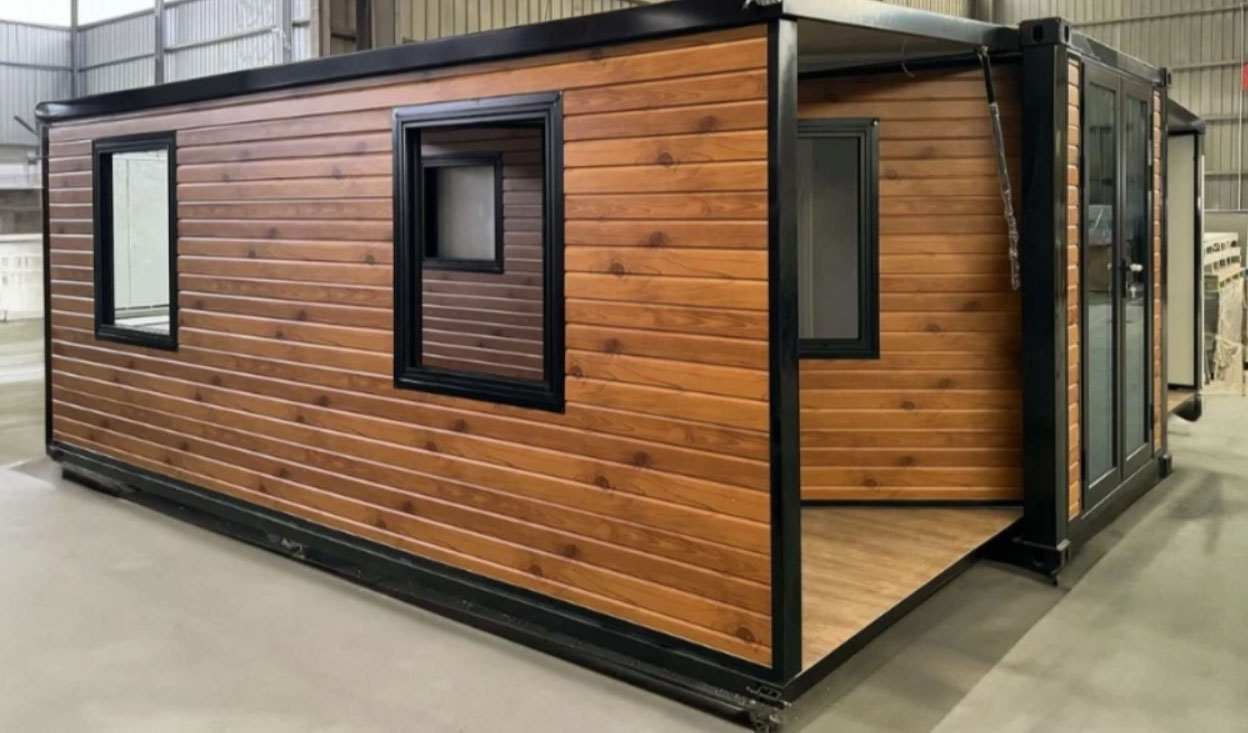
What Is a European Standard Expandable Container House?
A European standard expandable container house is a factory-built modular dwelling that has been specifically engineered, tested, and certified to meet the full suite of European Union construction and product regulations — not simply a standard export product relabelled for the European market.
The term covers four distinct compliance dimensions:
1. Structural design to Eurocode 3 (EN 1993) The steel frame must be designed and independently certified under EN 1993 — the EU's definitive standard for structural steel. This includes load calculations specific to the installation location: wind speed zone, ground snow load, and seismic activity level. A standard Chinese export unit carries a GB 50017 structural certificate, which European building authorities do not recognise.
2. CE marking under EU CPR 305/2011 Under the EU Construction Products Regulation (CPR 305/2011), all structural building products placed on the European market must carry CE marking supported by a Declaration of Performance (DoP). This is not a self-issued sticker — it requires an independent EU notified body to audit the manufacturer's factory production control system. The DoP document specifies the exact performance levels the product achieves for each declared characteristic.
3. Energy performance compatible with EU directives France's RE 2020, Germany's GEG 2023, and the EU's Energy Performance of Buildings Directive (EPBD) all set minimum thermal performance requirements for new residential buildings. A European standard expandable container house uses Rock Wool insulation (λ ≤ 0.040 W/m·K), Low-E double glazing, and thermally broken frames to achieve the U-values required in each national market.
4. EU-standard electrical system The unit must be factory-wired to 230V/50Hz with Type F (Schuko) sockets and RCBO circuit protection compliant with EU Low Voltage Directive 2014/35/EU. A non-European-standard unit typically arrives with Chinese 220V wiring and non-EU socket formats, requiring complete rewiring before legal grid connection.
CE Certification: What It Actually Means (and What It Does Not)
CE marking is the most misunderstood element of the European standard expandable container house specification. Here is the precise legal definition:
What CE Marking Requires
Under EU CPR 305/2011, CE marking for a construction product requires:
Factory Production Control (FPC) system: The manufacturer must have a documented quality management system for consistent production, audited by an EU notified body
Declaration of Performance (DoP): A formal document, signed by the manufacturer, declaring the product's performance against each essential characteristic covered by the harmonised standard
Notified Body assessment: For most structural products, an independent notified body (a third-party conformity assessment body recognised by an EU member state) must evaluate and verify the manufacturer's FPC system
CE marking on the product: The CE mark must be accompanied by the DoP document number, the notified body identification number, and the year of first affixing
What CE Marking Does Not Mean
CE marking is not a quality award, a safety guarantee, or a government approval. It is a declaration by the manufacturer that the product meets the harmonised European standards for its category. The manufacturer bears legal responsibility for the accuracy of that declaration.
CE vs Non-CE: The Real Consequences for Buyers
This is where the theoretical difference becomes a practical and financial one.
Building Permit (Planning Permission)
When you submit a building permit application in Germany (Baugenehmigung), France (Permis de Construire), Spain (Licencia de obras), Portugal (Licenciamento), or Greece (Οικοδομική Άδεια), the local building authority will require evidence that the structure meets EU construction product standards.
A CE Declaration of Performance with EN 1993 structural engineering calculations satisfies this requirement directly. A non-CE unit requires expensive third-party re-certification — if it is achievable at all.
Building Insurance
European building insurers assess structural compliance as part of policy underwriting. A non-CE-certified structure may be:
Classified as an uninsurable temporary structure
Subject to significantly higher premiums
Excluded from storm, flood, or structural failure coverage
A CE-certified European standard expandable container house is classified as a permanent compliant structure and insured accordingly.
Utility Connection
German and French utility providers require electrical installations to comply with local wiring standards before authorising grid connection. A non-EU-standard electrical system — Chinese voltage and socket format — will be rejected by the network operator's inspection. Rewiring a factory-installed Chinese electrical system costs €2,000–€5,000 and delays connection by 4–8 weeks.
Resale Value
A CE-certified, council-approved European standard expandable container house is a registered permanent structure on the property. An unapproved, non-CE structure is a liability — requiring mandatory disclosure and often forced removal when the property is sold. CE-certified units consistently command 15–25% higher resale values than non-certified equivalents.